


According to The Defense Post’s 23 May 2026 report, NMI’s command staff is working through “various scenarios” and a “step-by-step” approach to phasing the mission back into Iraqi territory. The March 2026 relocation to Naples was a precaution after the 28 February US-Israel strikes on Iran raised the regional risk threshold — though, per Hintzy, “we were never in any danger, even during the more difficult events.” NMI’s mandate dates to 2018 and centers on non-combat advisory work, training and capacity-building inside Iraq’s Ministry of Defense.
At a Glance
- Operation: NATO Mission Iraq (NMI) — non-combat advisory and training mandate
- Established: 2018, Brussels summit decision
- Evacuation: 18-20 March 2026, Baghdad → Naples
- Trigger: 28 February 2026 US-Israel coordinated Iran strikes
- Outgoing commander: Gen. Christophe Hintzy (France)
- New commander: Lt. Gen. Ramón Armada Vázquez (Spain), May 2026
- Previous footprint: ~750 personnel (21 nations) + 500 contractors
- Return target: ~300 personnel, “much smaller setup”
Background: NMI’s History and the 28 February Break
NATO Mission Iraq was set up after a formal 2018 request from the Iraqi government as a non-combat advisory + training mission. Its staff are unarmed, carry no combat equipment and provide strategic counsel to Iraq’s Ministry of Defense as well as specialist instruction at Iraqi military academies. The mission is operationally distinct from the former Inherent Resolve coalition and reports to NATO’s Joint Force Command Naples. According to NATO’s own factsheet, NMI has drawn personnel from 21 allied and partner nations.
The 28 February 2026 overnight US-Israel coordinated strike on Iran’s nuclear and missile infrastructure rapidly escalated regional risk. Baghdad-based U.S. and allied military facilities sat on the most likely Iranian retaliation vectors. Iraqi News confirmed in March 2026 that the NMI repositioning was a precaution and that the mission did not terminate — operations continued remotely from Naples.

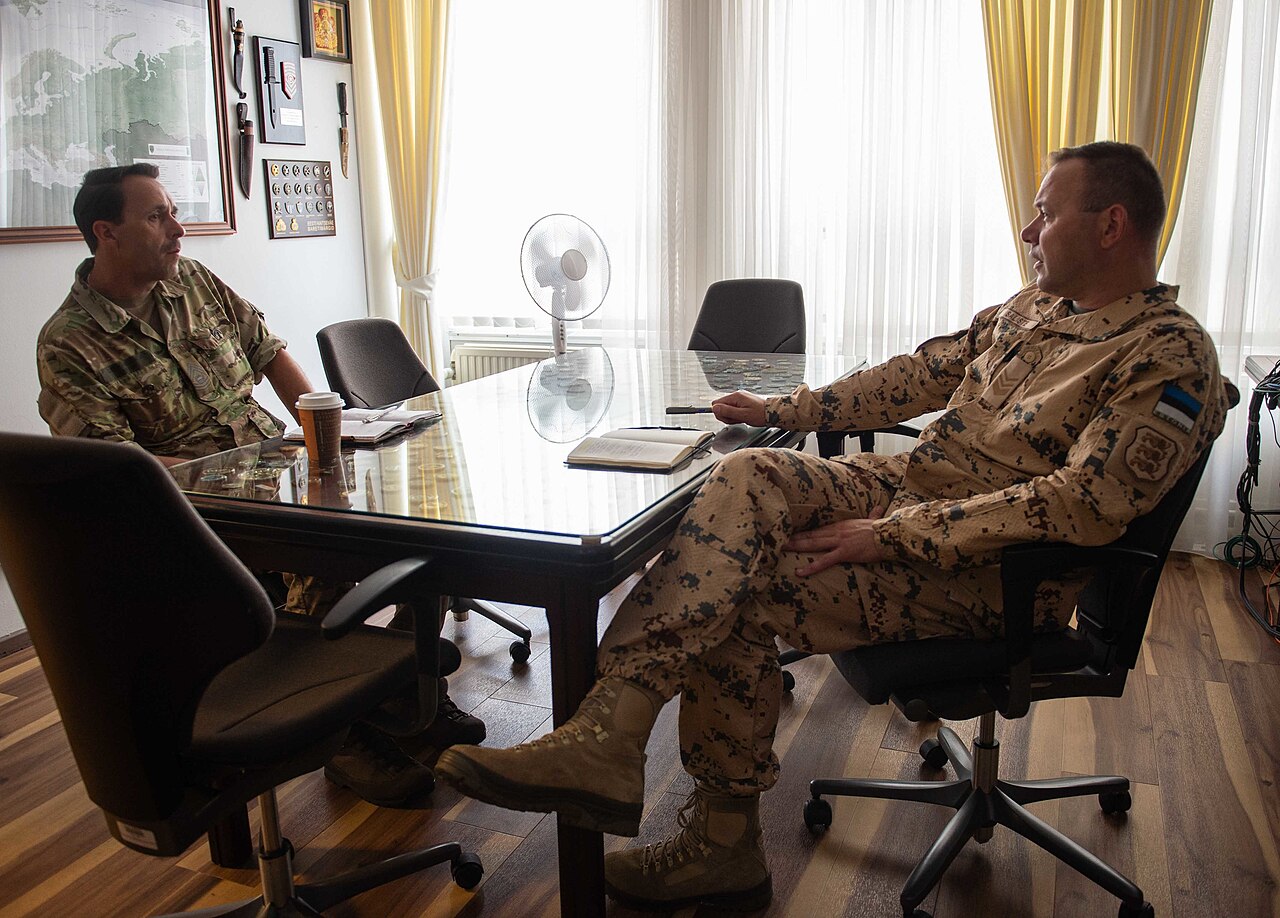
The New Architecture: Same Mission, Smaller Footprint
The pivotal line in Hintzy’s interview with The Defense Post is direct: “We won’t be going back in the same configuration. It will be a much smaller setup.” The signal is that the 750+500 footprint will be replaced by roughly 300 personnel in a more compact arrangement. Expected features include:
- Downsized headquarters: Symbolic Baghdad presence; most staff functions managed remotely from Naples
- Training nodes: Embedded small advisory teams directly inside Iraqi military academies
- Reduced contractor reliance: The 500-contractor figure expected to drop materially
- Phased re-entry: Step-by-step return tied to security assessment, not a single redeployment
Lt. Gen. Armada Vázquez, taking command in May 2026, is the officer who will steer the rebuild. He reports through NATO Joint Force Command Naples.
NMI Command Change and Status Timeline
| Period | Event | Detail |
|---|---|---|
| 2018 | NMI established | Brussels summit decision; Iraqi government request |
| 2018-Feb 2026 | Baghdad-based operations | ~750 staff + 500 contractors; 21-nation contribution |
| 28 Feb 2026 | US-Israel Iran operation | Regional risk assessment elevated |
| 18-20 Mar 2026 | Evacuation → Naples | All personnel moved to JFC Naples |
| May 2026 | New commander in post | Lt. Gen. Armada Vázquez (Spain) succeeded Hintzy (France) |
| Coming months | Phased return | ~300 personnel, step-by-step |
Why It Matters for Turkey
NMI’s return touches Türkiye’s defense industry and security architecture on three distinct axes. First, the northern-Iraq air-operations axis: the Turkish Armed Forces’ Operation Claw and Bayraktar TB2/TB3, AKINCI and AKSUNGUR UCAV strikes on PKK targets require institutional coordination with Baghdad. A NATO presence in Baghdad opens an allied intelligence-sharing channel.
Second, Iraqi armed-forces modernization: Baghdad’s procurement decisions create direct export windows for Turkish offerings — HİSAR air defense, KİRPİ MRAP, the Bayraktar UCAV family, ROKETSAN’s anti-armor portfolio — all NATO-standard but supplier-independent. Iraq has already received Bayraktar deliveries; NMI’s return brings standardization and training modules that ease Turkish system integration. Türkiye’s edge is concrete: a NATO-compatible portfolio with sovereign software stack and combat-proven operational maturity, free of Western-supplier veto risk.
Third, Türkiye’s buffer role in the Iran-Israel-US triangle: NMI’s “smaller-but-present” posture signals that NATO is not abdicating the region. That matters for Türkiye, which can stay inside an allied framework rather than carrying the regional security load alone. ASELSAN-HAVELSAN command-and-control suites, ROKETSAN’s precision-munitions family and TUSAŞ’s UCAV portfolio give Türkiye the elasticity to remain supplier-sovereign while interoperable with NATO coordination.
Frequently Asked Questions
Is NMI the same as Operation Inherent Resolve? No. Inherent Resolve is the US-led International Coalition against ISIS and includes a combat mandate. NMI was set up in 2018 under a NATO framework as a non-combat advisory + training mission; its personnel are unarmed.
Does NMI personnel fight in Iraq? No. NMI’s mandate is wholly non-combat. Its work is strategic counsel to Iraq’s Ministry of Defense and specialist instruction at Iraqi military academies.
Is Türkiye among the 21 contributing nations? As a NATO member, Türkiye is eligible to contribute and historically has. NATO does not always disclose national breakdowns. Türkiye also runs a separate bilateral coordination track with Iraq tied to Operation Claw.
Is a 300-person footprint enough? Hintzy’s “much smaller setup” describes a narrower contact surface rather than a narrower mandate. More remote coordination from Naples plus on-site presence only at critical touchpoints makes the model sustainable.
Bottom Line
NMI’s phased return to Baghdad is the next chapter in NATO’s “presence but low profile” Middle East doctrine. The fact that the regional architecture has permanently shifted after the US-Israel Iran operation means border states like Türkiye will keep NATO in their security calculus. The Turkish defense industry’s opportunity is to combine the NATO standard with sovereign superiority in Iraqi modernization programs — Bayraktar exports, HİSAR offers and KİRPİ MRAP all belong on the Baghdad table.