


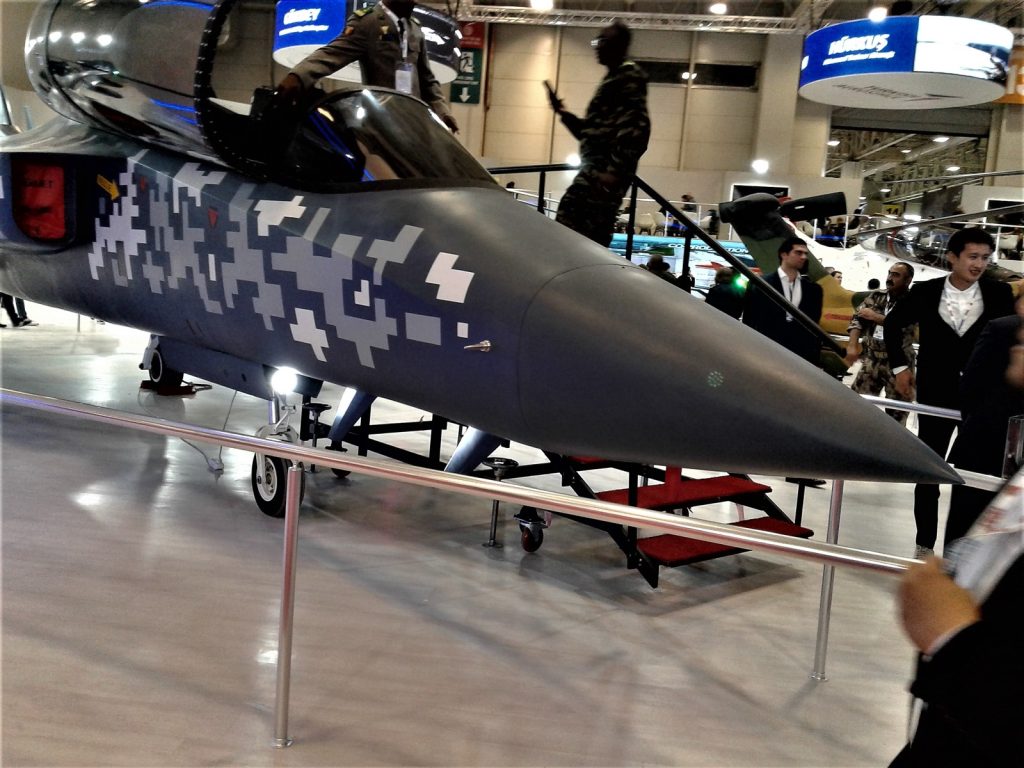
Image: TAI HÜRJET prototype on display. Photo by CeeGee, Wikimedia Commons, CC BY-SA 4.0.
For decades the Turkish Air Force trained its student pilots in 1960s-vintage American T-38 jets, and put the same era’s F-5s through aerobatic loops with the Turkish Stars display team. By the 2020s, those airframes were past 50 and getting harder to keep airworthy by the year. Buying a replacement abroad would have been expensive and politically exposed. Turkey took the harder option instead: it asked TUSAŞ to design and build the trainer itself. The result is HÜRJET.
In plain terms, HÜRJET is the jet a student pilot flies on the way to an F-16 or, soon, the Turkish fifth-generation fighter KAAN. But it is also a supersonic light-attack aircraft in its own right — capable of carrying weapons on combat missions — and, in time, the new mount of the Turkish Stars aerobatic team. One airframe, several jobs.
The first prototype lifted off on 25 April 2023. A year later it crossed the Mediterranean to Egypt and performed a display flight over the Pyramids of Giza. For a domestically-built jet trainer making its first overseas appearance, that was a historic image: a Turkish-designed supersonic aircraft turning over one of the world’s most photographed skylines.
At a Glance
Translated to everyday terms: HÜRJET crosses the sound barrier comfortably (around 1,700 km/h), climbs about three kilometres higher than an airliner, and has the legs to fly Istanbul to Berlin and back on a single load of fuel. The 3.4-tonne external payload is roughly the weight of a mid-size European car, hung under the wings as weapons, fuel tanks, or pods.
What HÜRJET Actually Does
A Turkish Jet Over the Pyramids
The single most-replayed HÜRJET moment came in 2024 during the Egypt trip. TUSAŞ pilots flew the jet across the Mediterranean, displayed it at the Cairo air show, and added a low pass over the Pyramids of Giza. The images travelled across both Turkish and Arabic-language media — it was the first time a Turkish-designed jet had performed an overseas display.
That same year, the second prototype (P2) was completed and made its maiden flight on 12 November 2024. A third airframe is in build. TUSAŞ is aiming for first deliveries of serial-production HÜRJETs to the Turkish Air Force in 2026 — meaning this year, the type begins entering frontline inventory.
Specifications
| Specification | Value |
|---|---|
| Length | 13.6 m (roughly the length of a large truck) |
| Wingspan | 9.5 m |
| Height | 4.1 m |
| Top Speed | Mach 1.4 (~1,700 km/h) |
| Service Ceiling | 13.7 km (45,000 ft) — higher than a typical airliner |
| Range | ~1,960 km (roughly Istanbul–Berlin) |
| Rate of Climb | 14.8 km/min (48,500 ft/min) — 246 m gained every second |
| G Limits | +8g / −3g (pilot feels up to eight times their own weight in hard manoeuvres) |
| Payload | 3,400 kg (7,500 lb) — weapons, drop tanks, pods |
| Engine | General Electric F404-104 (licence-produced) |
| Thrust | 17,700 lbf (78.7 kN) |
| Crew | 2 — student in front, instructor behind |
How HÜRJET Compares Internationally
| Aircraft | Origin | Role |
|---|---|---|
| HÜRJET | TUSAŞ — Türkiye | Supersonic jet trainer + light attack |
| M-346 Master | Leonardo — Italy | Lead-in fighter trainer |
| T-50 Golden Eagle | KAI — South Korea | Jet trainer + light fighter |
| L-39NG | Aero Vodochody — Czechia | Advanced jet trainer |
Why It Matters for Turkey
The Air Force’s T-38s were built in the 1960s. The Turkish Stars’ F-5s are the same generation. Spare parts are scarce, sustainment is increasingly expensive, and the safety case erodes a little further every year. HÜRJET coming online means a generation of pilots will train on a modern, safe, locally-built jet — and that retirement of the legacy fleet finally has a destination on the calendar.
The export angle is the second half of the case. Worldwide, fewer than ten countries design and produce a supersonic jet trainer of their own: Italy (M-346), South Korea (T-50), Czechia (L-39NG), and a handful of others. Joining that club gives Turkey a seat at the table — and any country that buys the airframe becomes a long-term customer for spares, upgrades and weapons integration.
HÜRJET is also a forcing function for the indigenous engine. Today it flies on a licence-built General Electric F404. The longer-term plan is to swap that for a TEI-developed Turkish turbofan. Until that engine flies, HÜRJET is the airframe waiting for it — which makes it doubly central to Turkish aviation’s next chapter.
Summary
| Name | HÜRJET |
|---|---|
| Builder | TUSAŞ (Turkish Aerospace Industries) |
| Class | Indigenous supersonic jet trainer + light attack |
| Replaces | T-38 jet trainers and F-5 aerobatic display jets |
| Maiden flight | 25 April 2023 (P1), 12 November 2024 (P2) |
| First delivery | 2026 — Turkish Air Force |
Sources: