
CH-4 (Caihong-4) Combat UAV: China’s MALE-Class Export Champion — Specs, Operators, Pakistan and Iraq Combat Use Explained
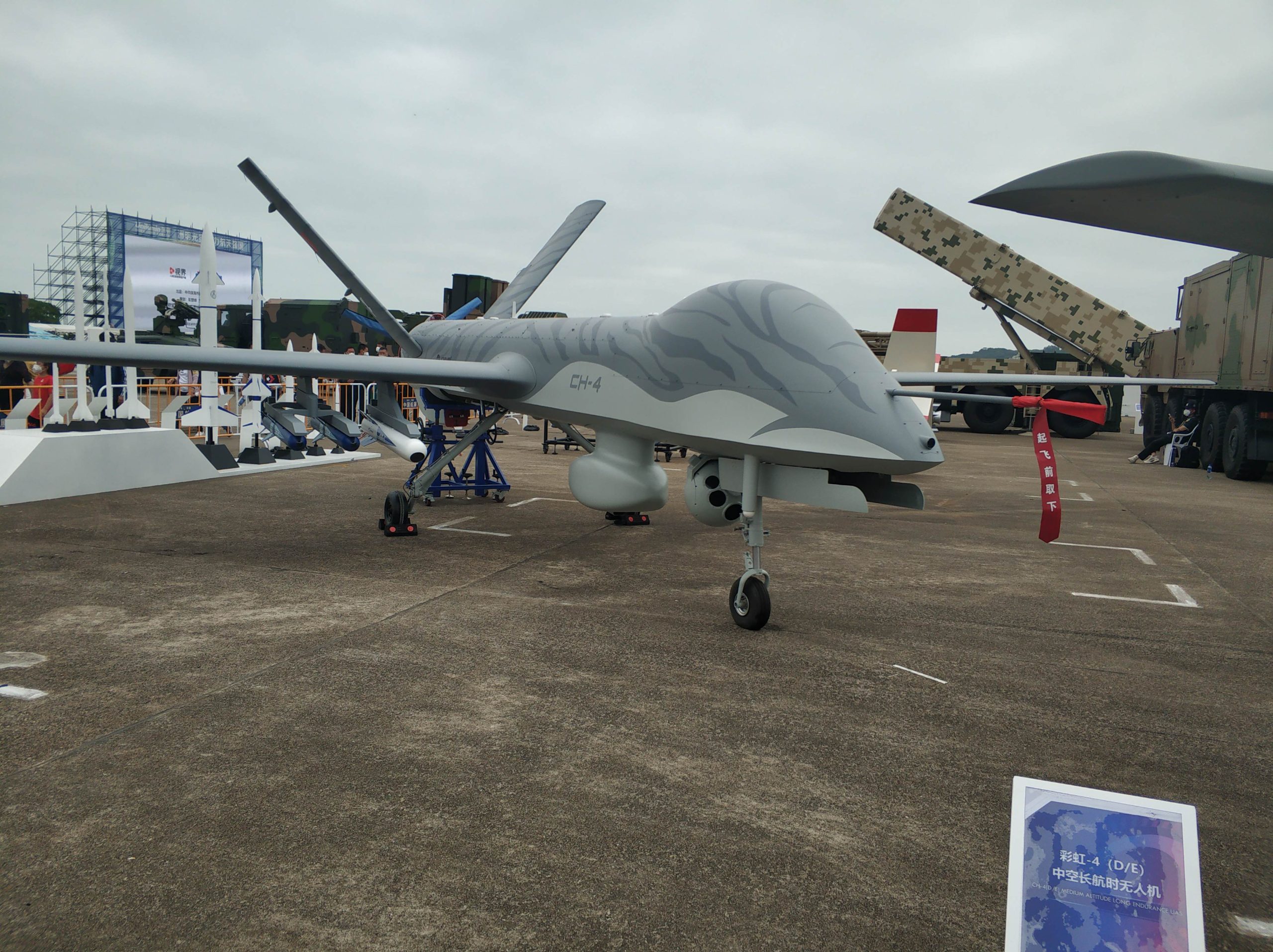
The CH-4, or Caihong-4, is a medium-altitude long-endurance (MALE) armed unmanned aerial vehicle developed by the China Academy of Aerospace Aerodynamics (CAAA) under China Aerospace Science and Technology Corporation (CASC). It has become China’s most successful combat-UAV export, filling a void left by US restrictions on MQ-1 Predator and MQ-9 Reaper sales. Since entering operational service in 2014, the platform has been deployed in real combat by Pakistan, Iraq and Egypt, and has accumulated more than a dozen national operators across the Middle East, Africa and Asia.
What is the CH-4?
CH-4 is the fourth generation of the Caihong (Chinese: 彩虹, “rainbow”) family. It is produced in two main variants: CH-4A is the reconnaissance configuration, while CH-4B is the armed version that drove the export wave. Its first flight took place in 2011 and it entered operational service in 2014, quickly becoming the symbol of the “China sells what the US will not” trend.
CASC positions CH-4 explicitly as an alternative to the General Atomics MQ-1 Predator. The aerodynamic silhouette, V-tail layout and chin-mounted electro-optical turret share a clear visual lineage with the Predator family. The engine, however, is a Chinese turbo-piston in the 100 hp class, and the data-link, avionics and weapons interfaces are entirely domestic.
What Does It Do?
The CH-4 operational role can be summarised under four mission sets:
- Persistent intelligence, surveillance and reconnaissance (ISR): 30+ hours of endurance allows a single sortie to cover an entire border zone or area of operations.
- Precision strike: Carries AR-1 (laser-guided mini missile), AR-2, FT-7/FT-9 guided bombs and AKD-10 anti-tank missiles. Total external load is around 345 kg across four hardpoints.
- Counter-insurgency and border security: Pakistan, Iraq and Egypt have all used the platform in low-intensity conflict, especially in tribal areas and desert operations.
- Maritime surveillance: Coastal configurations have been deployed for vessel detection and exclusive economic zone monitoring.
Technical Specifications
| Parameter | Value |
|---|---|
| Manufacturer | CASC / CAAA (China) |
| First flight | 2011 |
| In service | 2014 |
| Length | 8.5 m |
| Wingspan | 18.0 m |
| Empty weight | ~800 kg |
| MTOW | 1,330 kg |
| Payload | 345 kg (4 hardpoints) |
| Engine | 100 hp class turbo-piston |
| Cruise speed | 180 km/h |
| Max speed | 235 km/h |
| Ceiling | 7,300 m |
| Endurance | 30-40 h |
| Data link | LOS + SatCom (CH-4B) |
| Weapons | AR-1, AR-2, FT-7/FT-9, AKD-10, TG100 |
| Sensors | EO/IR/LDP chin turret, optional SAR |
Operators and Contracts: Who Bought, How Much
CH-4 is the locomotive of China’s combat UAV export market. The customer base exceeds ten national operators, mostly countries shut out of US Predator or Reaper sales.
| Country | Units / Notes |
|---|---|
| Pakistan | 50+ — local “Burraq” variant in parallel use |
| Iraq | 4-6 — 260+ strike sorties against ISIS (2015-2017) |
| Egypt | Active over the Sinai peninsula, numbers undisclosed |
| Saudi Arabia | CH-4B procurement + licensed production claim (2017 agreement) |
| Algeria | CH-4B from 2016, used in desert operations |
| Jordan | 6 units (2016), later retired and offered for resale |
| Indonesia | Small batches since 2019 |
| Turkmenistan | Small fleet for border surveillance |
| UAE | Early adopter, later migrated to Wing Loong II |
Unit price sits in the $4-5 million range; full packages including ground control stations and training are reported in the $7-9 million per aircraft band (SIPRI and IISS open-source figures).
Why It Matters for Turkey
Turkish defence industry has reached an integration and export maturity in the MALE / HALE segment that CH-4 has not. The comparison is meaningful at the ecosystem level, not just product against product.
| Criterion | CH-4B (China) | Anka-S (Turkey, TAI) | Akıncı (Turkey, Baykar) |
|---|---|---|---|
| Class | MALE | MALE | HALE |
| MTOW | 1,330 kg | 1,700 kg | 5,500 kg |
| Ceiling | 7,300 m | 9,100 m | 12,000+ m |
| Payload | 345 kg | 350 kg | 1,500 kg |
| Endurance | 30-40 h | 24-30 h | 24+ h |
| SatCom control | CH-4B only | Standard (Türksat) | Standard |
| NATO integration | None | STANAG 4671 certification path | STANAG-compliant weapons bay |
| Weapons | AR-1/AR-2, FT bombs | MAM-L/T, Bozok, L-UMTAS | MAM-T, SOM-J, Bozdoğan/Gökdoğan air-to-air |
| Operators | ~10 countries | Turkish Armed Forces + export deals | 10+ countries, rapid growth |
Turkey’s edges are clearly visible: NATO compliance, breadth of indigenous munitions (Roketsan MAM-T/L, SOM-J, Bozdoğan/Gökdoğan air-to-air missiles), Bayraktar Akıncı’s air-to-air capability (absent on any CH-4 variant) and integration with Aselsan EO/IR (CATS). Akıncı’s 1,500 kg payload is more than four times CH-4’s and creates a class gap in strategic strike.
Turkish industry also leads on export performance: Bayraktar TB2 has been sold to more than 31 countries, and Akıncı is already in service with more than 10. CH-4 has filled customer demand mostly by default in markets the US closed; Turkish UAVs are chosen on operational proof (Syria, Karabakh, Libya, Ukraine).
Frequently Asked Questions
Is the CH-4 the same as Wing Loong II?
No. CH-4 is built by CASC, Wing Loong II by AVIC (Chengdu Aircraft Industry). Both are Chinese MALE UAVs but they come from different design bureaus and use different weapons fits.
What weapons does the CH-4 carry?
Standard fit: 4x AR-1 laser-guided missiles (HJ-10 class, 8 km range, 10 kg warhead), AR-2 light variant, FT-7/FT-9 small-diameter guided bombs, AKD-10 anti-tank missile and TG100 small bomb. A typical loadout uses two hardpoints for missiles and two for bombs.
What are CH-4’s disadvantages versus Turkish UAVs?
Three gaps stand out: no integration with NATO data-link standards, no air-to-air capability, and no compatibility with Western sensors or munitions. On the positive side, attractive pricing, licensed-production flexibility and freedom from US export restrictions keep customers coming.
Why did Pakistan buy the CH-4?
Pakistan turned to CH-4 in 2014 after repeated US refusals on Predator/Reaper requests. The indigenous Burraq programme followed with technology transfer from the CH-3/CH-4 platform. Today Pakistan is one of the few states operating both Chinese and Turkish UAVs (Bayraktar Akıncı is also in service).
Does Turkey produce a CH-4 equivalent?
Yes. Both TAI Anka-S and Baykar Akıncı sit in the same class or above, with modern munitions such as MAM-T and SOM-J already integrated. Air-to-air capability (via Bozdoğan/Gökdoğan), high payload, NATO-compliant data-links and Aselsan sensor integration set the Turkish systems apart from other export MALE/HALE platforms.
Bottom Line
The CH-4 is the centrepiece of the Caihong series and China’s most successful armed-UAV export. 30+ hours of endurance, a 345 kg payload and an affordable price tag make it especially attractive to countries blocked from US options. Turkish industry, however, fields TAI Anka-S and Baykar Akıncı in the same or superior class, with NATO-compliant weapons, air-to-air capability and Aselsan sensor integration that make the Turkish platforms combat-proven choices in their own right.
Sources
- Wikipedia — “CASC Rainbow” (en.wikipedia.org/wiki/CASC_Rainbow)
- SIPRI Arms Transfers Database — China UAV exports
- IISS Military Balance 2024 — operator listings
- Janes Unmanned Vehicles & Robotics annual 2023 — CH-4 specifications
- CASC corporate publications, AVIC Beijing 2018-2022 air show notes


