MURAD AESA: Turkey’s Homegrown Fighter Radar That Joins the World’s Five-Country Club, Explained
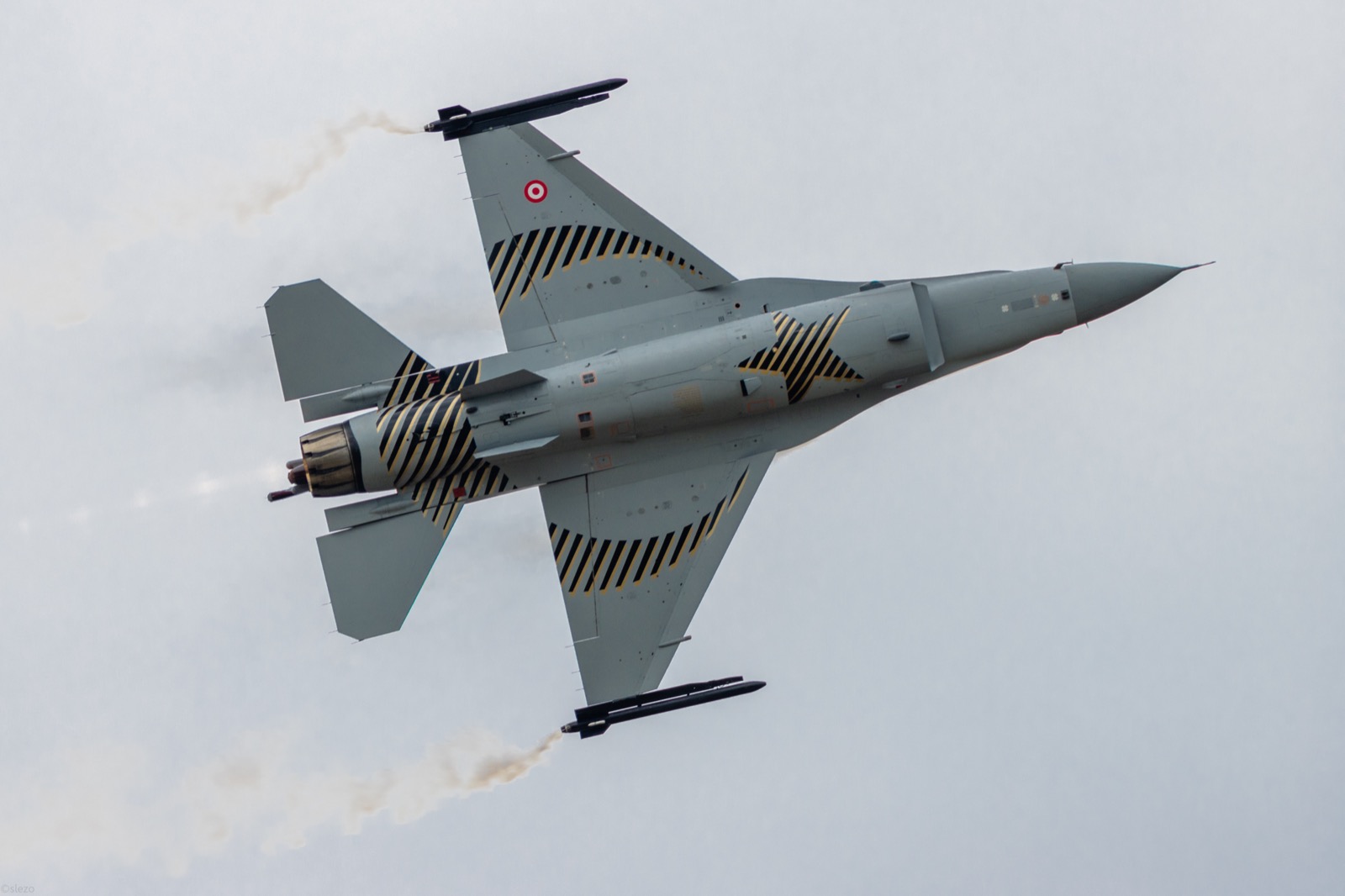
Image: Turkish Air Force SoloTürk F-16 — one of the platforms targeted for MURAD AESA upgrade. Photo by slezo (via Flickr), Wikimedia Commons, CC BY 2.0.
The most important component of a modern fighter aircraft is not its engine — it is its nose radar. In a 21st-century air war, the rule is brutally simple: whoever sees the other first, shoots first. The dogfighting era is largely over. Today’s pilot wants to detect, identify and engage a hostile aircraft hundreds of kilometres away, ideally before the enemy even knows there is a contact on the scope. Doing that depends on one specific thing: a fast, sensitive, smart radar in the nose of the aircraft.
Turkey flew its F-16s for years with the American AN/APG-68 — a capable radar in its day, but now a generation behind. The next generation is the AESA (Active Electronically Scanned Array), and Turkey was dependent on Washington to supply it. ASELSAN set out to break that dependency, and the result is the MURAD AESA family. With MURAD, Turkey is on track to become only the fifth country in the world able to build its own combat-grade fighter radar from scratch.
Unlike older radars, MURAD has no moving parts. Instead of one big antenna that physically swings around, the array is built from hundreds of tiny “transmit-receive” modules, each working independently. The radar beam is steered electronically — instant scans, multiple simultaneous targets, and a fighting chance against low-observable aircraft.
What Does “AESA” Actually Mean?
MURAD AESA at a Glance
Translated to everyday terms: MURAD does everything a modern fighter radar is expected to do, in a single box. It can track dozens of enemy aircraft at once, sort them by threat priority, and compute the right firing moment for the pilot. It can also look down and detect ground targets — tanks, trucks, convoys — through cloud or darkness. One radar, two jobs.
What MURAD AESA Actually Does
“One of Five Countries” — What That Means
The number of countries that produce a combat-grade fighter AESA radar can be counted on one hand: the United States (Northrop Grumman, Raytheon), Israel (Elta), Russia (Tikhomirov), Europe (Selex/Hensoldt — an Italian–British–German joint product), and China. With MURAD, Turkey through ASELSAN is on the brink of joining that club with a fully indigenous, GaN-based, exportable radar.
The strategic implication is enormous. Until now, every F-16 modernisation programme — refurbishing existing airframes rather than buying new ones — and every new F-16V buy depended on Washington’s willingness to sell an American AESA. If that sale was blocked, the upgraded jet would not actually be modern. With MURAD, Turkey can fit its own radar into its own F-16s.
The deeper implication is what comes next: the radar in the nose of KAAN is expected to be a scaled-up MURAD variant. A fifth-generation fighter cannot meaningfully be fifth-generation without an AESA, and Turkey is now building its own.
Specifications — MURAD 110-A (Brochure Data)
| Specification | Value |
|---|---|
| Type | AESA fire-control radar for combat aircraft |
| Frequency Band | Wide-band (modern AESA standard) |
| Semiconductor | Gallium Nitride (GaN) — current generation, higher power, better efficiency than older GaAs |
| Beam Steering | Agile electronic steering (no mechanical movement) |
| Concurrent Modes | Air-to-air and air-to-ground operating simultaneously |
| Signal Processing | Sub-array level digital beam forming |
| Reliability | Graceful degradation — keeps working with multiple module failures |
| Air-to-Air Modes | BVR missile guidance, multi-target tracking, helicopter detection, weather |
| Air-to-Ground Modes | High-resolution SAR imaging, ground target tracking, mapping |
How MURAD Compares Internationally
| Radar | Maker / Country | Typical Platform |
|---|---|---|
| MURAD AESA | ASELSAN — Türkiye | F-16, KAAN, HÜRJET |
| APG-83 SABR | Northrop Grumman — USA | F-16V upgrades |
| Captor-E | Hensoldt / Leonardo — Europe | Eurofighter Typhoon |
| EL/M-2052 | Elta — Israel | F-16, FA-50, Tejas (export) |
| Byelka N036 | Tikhomirov — Russia | Su-57 |
Which Aircraft Will Carry MURAD
- F-16 Block 30/40/50 modernisation — the Turkish Air Force’s existing F-16 fleet will be progressively upgraded with MURAD AESA. The same airframes effectively jump a generation in capability.
- KAAN — Turkey’s fifth-generation fighter is expected to fly with a larger MURAD-family radar in its nose. AESA is non-negotiable for a fifth-generation classification.
- HÜRJET (armed variant) — integration is on the roadmap for the light-attack version.
- Export — built to NATO standards, MURAD is positioned for export to other F-16 operators looking for an alternative to the American AESA.
Why It Matters for Turkey
MURAD AESA is a strategic step that is easy to underestimate because it sits inside a nose cone. Until now, Turkey bought the “brain” of its fighters from abroad. If the supplier said no, the fleet stopped being modern. With ASELSAN’s MURAD entering the field, that lever disappears. Turkey is now able to put its own radar into its own fighter.
In the longer term, MURAD is not just a radar — it is an ecosystem. From the gallium-nitride microchips embedded in each transmit-receive module, to the RF signal-processing software, to the cooling systems, the whole stack is now domestic. That same stack will end up in electronic-warfare pods, ground-based air-defence radars, and satellite radars. ASELSAN is not only producing a radar; it is laying the foundation of the next decade of Turkish defence electronics.
Summary
| Name | MURAD AESA (110-A variant in brochure) |
|---|---|
| Builder | ASELSAN |
| Class | AESA fighter fire-control radar |
| Semiconductor | GaN (Gallium Nitride) |
| Target platforms | F-16, KAAN, HÜRJET (armed), future indigenous platforms |
| Turkey’s rank | On track to be the fifth country making its own fighter AESA |
| International peers | APG-83 (USA), Captor-E (Europe), EL/M-2052 (Israel), Byelka (Russia) |
Sources: